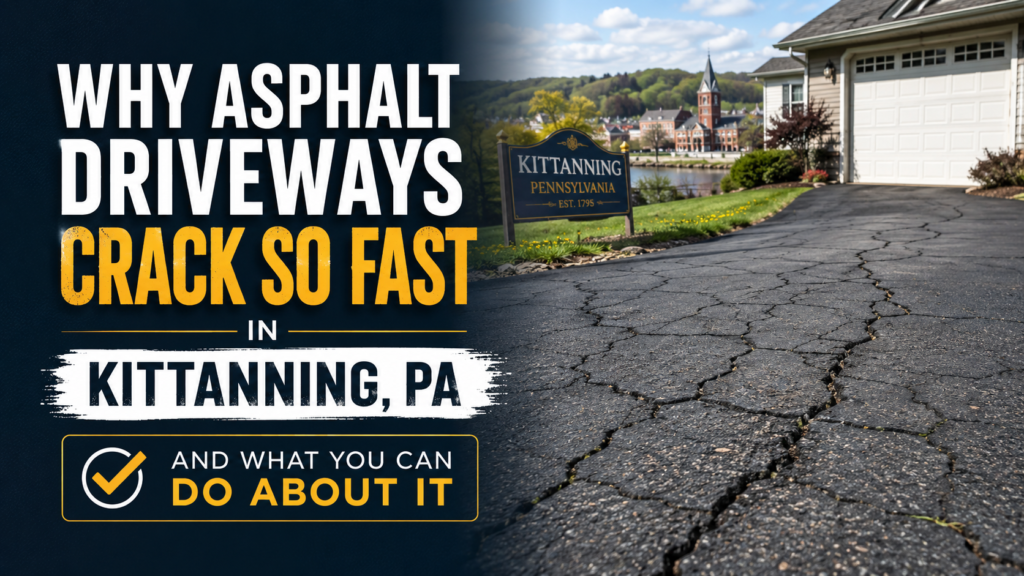
Kittanning homeowners invest in asphalt driveways expecting surfaces that will provide years of reliable, attractive service. And yet, it is a common experience in Armstrong County to see driveways that were freshly paved just a few years ago already showing cracks, edge crumbling, and surface deterioration that seems premature. This is not a sign of bad luck or necessarily poor workmanship though poor installation certainly accelerates the problem. It is a predictable result of the specific environmental and geological conditions that define Western Pennsylvania’s Kittanning area. Understanding exactly why Asphalt Driveways Kittanning crack so fast here and what prevents or slows the process is essential knowledge for any Kittanning property owner who wants to protect their paving investment.
The Freeze-Thaw Mechanism: The Engine of Driveway Damage
The single most destructive force acting on Kittanning driveways is the freeze-thaw cycle. Pennsylvania’s climate delivers this cycle to Armstrong County 30 to 40 times per year significantly more often than most homeowners realize. Each cycle works the same way:
- Water enters any surface crack or pore in the asphalt. This can be rainwater, snowmelt, or even condensation from humid air.
- Temperatures drop below 32 degrees Fahrenheit, and the water freezes. Ice occupies about 9 percent more space than liquid water a small percentage, but it represents enormous mechanical force when the ice has nowhere to expand except outward into the surrounding asphalt.
- The ice pushes the crack wider. When temperatures rise and the ice melts, the enlarged crack can admit more water.
- The next freeze cycle widens it further. And the one after that widens it further still.
This process turns hairline surface cracks into meaningful structural cracks in a single Pennsylvania winter. Cracks that are properly sealed before the freeze season before water can infiltrate do not experience this mechanical expansion. This is why crack filling before winter is the single most important maintenance practice for Kittanning driveways.
UV Oxidation: The Slow, Invisible Damage
Alongside freeze-thaw, a slower and less visible process continuously weakens asphalt driveways in Kittanning: ultraviolet oxidation of the asphalt binder. Asphalt pavement consists of mineral aggregate (crushed stone, sand, and gravel) held together by asphalt binder a petroleum-derived material that is flexible and adhesive when fresh. Over time, UV radiation from sunlight causes chemical changes in the binder, causing it to lose volatile oils, harden, and become brittle.
As the binder hardens, the asphalt surface loses its flexibility. Flexible asphalt can accommodate the minor ground movement, thermal expansion, and traffic loads it experiences without cracking; brittle, oxidized asphalt cannot. The first visible sign of UV oxidation is the graying of the surface the rich black of fresh asphalt fades to gray as the binder oxidizes. This is not merely cosmetic: it signals that the binder has lost significant flexibility and that the surface is now much more vulnerable to cracking from any mechanical stress.
Sealcoating directly addresses UV oxidation by creating a protective layer between the asphalt binder and sunlight. Regular sealcoating beginning 6 to 12 months after installation and repeated every 2 to 3 years maintains the binder’s flexibility and dramatically slows the natural aging process. Driveways that have never been sealcoated oxidize and become crack-prone much faster than those on a regular maintenance schedule.
Poor Sub-Base Preparation: The Hidden Problem That Shows Up Later
While freeze-thaw and UV oxidation act on every driveway in Kittanning regardless of how it was built, poor installation choices create additional vulnerability that accelerates cracking beyond what the climate alone would cause. The most common installation failure in Western Pennsylvania driveways is inadequate sub-base preparation.
A properly installed driveway is not just an asphalt layer on the ground it is a layered system. The asphalt surface layer depends entirely on the stability and drainage of the layers beneath it. When those layers are inadequate, the driveway fails structurally, not just cosmetically. Common sub-base failures include:
- Insufficient base depth: A 4 to 6 inch compacted aggregate base is the standard for residential driveways in Pennsylvania. Contractors who skip the base or install only 1 to 2 inches of stone beneath the asphalt produce driveways that flex excessively under vehicle loads, accelerating fatigue cracking.
- Inadequate compaction: Sub-grade soil and aggregate base must be thoroughly compacted before asphalt is applied. Uncompacted material settles over time, creating differential settlement that produces cracking above.
- Poor drainage design: Water trapped beneath an asphalt driveway from inadequate slope, from organic material that holds moisture, or from clay sub-grade that does not drain saturates the base and weakens it. Wet base material provides poor support, and vehicle loads on a poorly supported surface cause rapid cracking and pothole formation.
- Organic material in the sub-grade: Trees roots, decomposed leaves, stumps, and organic topsoil are highly compressible and will settle over time. Any organic material that remains in the ground beneath a driveway creates settling areas that appear as surface depressions and cracks within a few years.
Road Salt and Chemical Damage
Kittanning homeowners who apply road salt or calcium chloride to their driveways during winter should be aware of the cumulative effect on asphalt. Salt lowers the freezing point of water, which is helpful for ice management, but it also draws additional moisture into the asphalt surface, increasing the volume of water available to freeze in surface pores and cracks. Over multiple winters of heavy salt application, this can accelerate surface deterioration, particularly in combination with freeze-thaw cycling.
This does not mean avoiding de-icing products entirely safety in winter requires traction management. It does mean that homeowners using de-icing products should maintain their driveways with regular sealcoating to minimize the porosity through which salt-laden water can penetrate.
Drainage: The Factor That Determines How Fast Damage Progresses
On Kittanning’s hilly residential lots, drainage management is particularly important. Driveways that collect water from adjacent slopes, from inadequate driveway cross-slope, or from clogged edge drainage hold moisture in contact with the asphalt surface and in the surrounding soil. This prolonged moisture exposure dramatically accelerates every deterioration mechanism: binder softening, freeze-thaw damage, and sub-base weakening all proceed faster when water is present consistently rather than draining promptly.
A well-designed driveway in Kittanning has a cross-slope of 1 to 2 percent that moves water toward the edges, clear edge drainage that carries water away from the driveway area, and grading that prevents adjacent lawn or hillside runoff from flowing across the paved surface. These design elements are not complicated, but they require intentional planning during installation.
What Kittanning Homeowners Can Do
Given these multiple sources of driveway damage, a practical maintenance program for Kittanning asphalt driveways involves:
- Sealcoating every 2 to 3 years: Beginning 6 to 12 months after a new installation and repeated on schedule. This is the single most effective practice for extending driveway life in Armstrong County.
- Crack filling every fall: Before winter freeze cycles begin. Any crack wider than a hairline should be cleaned of debris and filled with flexible asphalt crack sealant before November.
- Keeping edges clear: Allowing grass and vegetation to overgrow driveway edges holds moisture against the asphalt perimeter, which is the most vulnerable section of any paved surface. Keeping edges clean and trimmed protects the margins where most driveways first begin to crumble.
- Managing drainage: Clearing any accumulated debris from edge drainage channels and ensuring that water flows promptly off the surface after rain or snowmelt.
- Avoiding concentrated loads in summer heat: During the hottest summer weeks, very hot asphalt can be damaged by vehicles with small contact points trailer jacks, RV stabilizer legs, and motorcycle kickstands can create indentations in soft summer asphalt. Use plywood pads under these point loads during peak summer heat.
Conclusion
Asphalt driveways crack fast in Kittanning, Pennsylvania because the environment there is genuinely demanding multiple freeze-thaw cycles per winter, UV exposure that oxidizes the binder, clay soils that move with moisture, and terrain that concentrates drainage all work against pavement longevity. The homeowners who fare best are those who invest in proper installation that includes adequate sub-base preparation and drainage design, and who commit to regular sealcoating and crack maintenance that prevents the climate from finding the vulnerabilities it would otherwise exploit.